

 Get started
 How-to guides
 Reference
 Concepts
 Self-host gallery
 Appendix
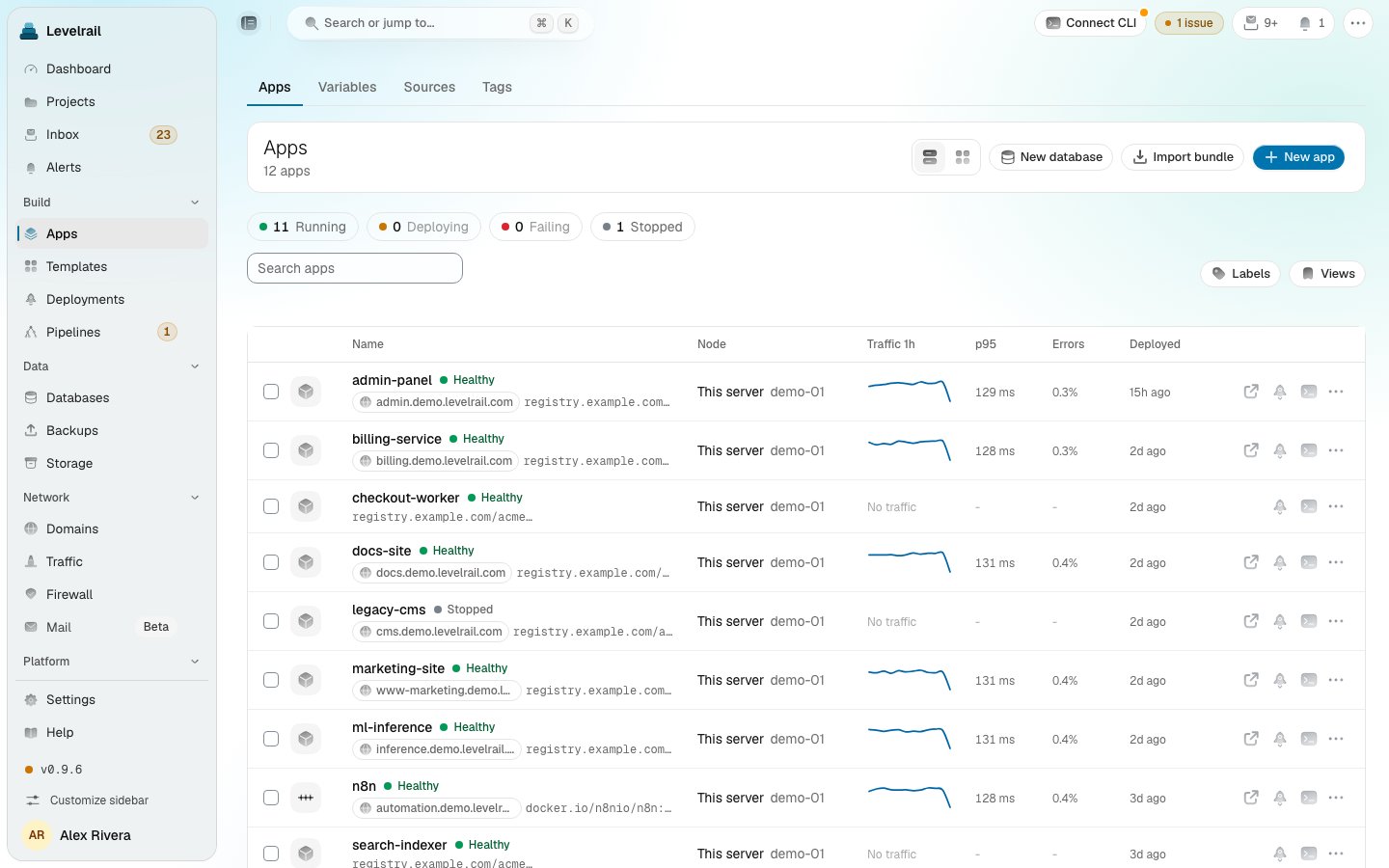
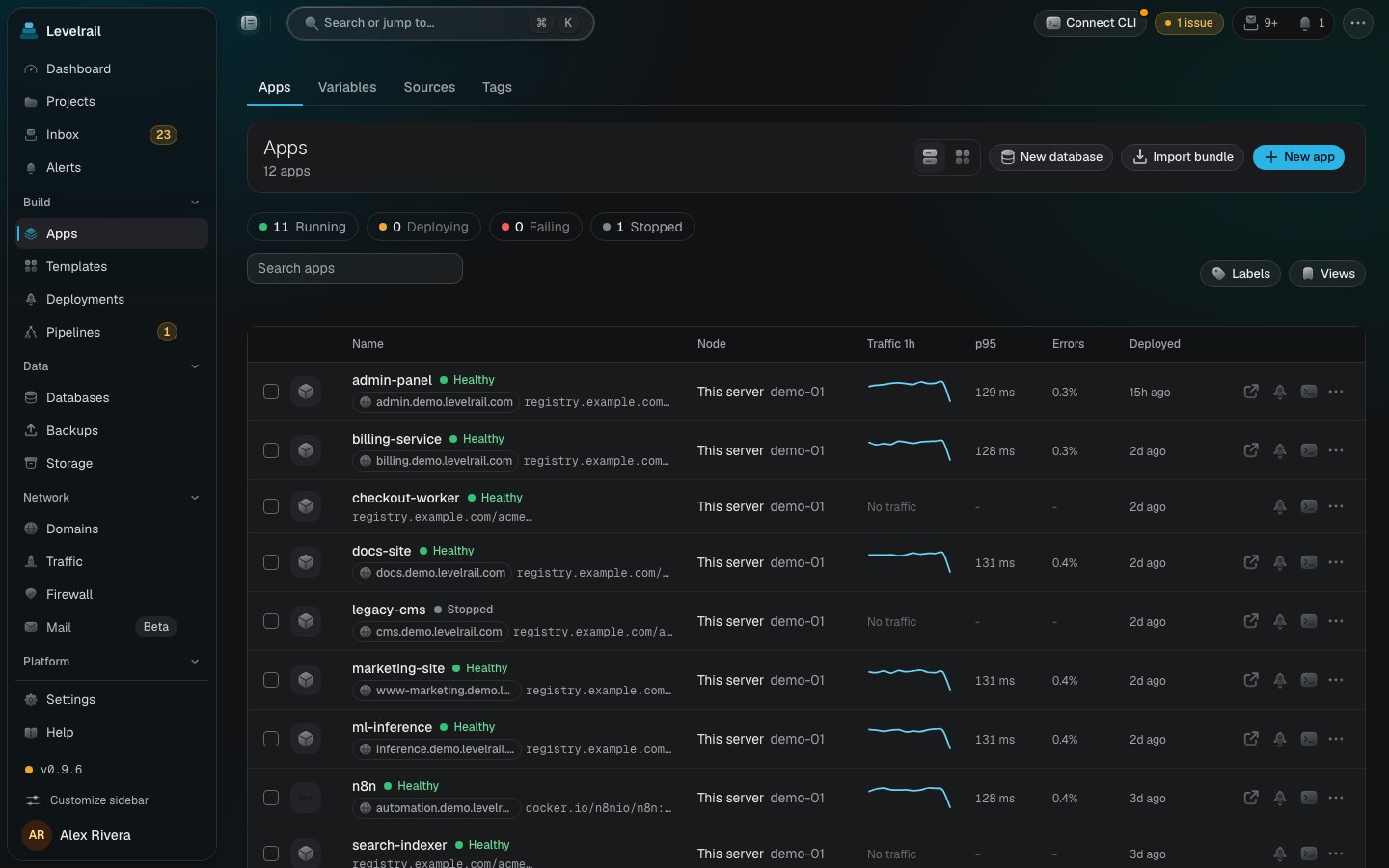
What you get
Services, domains and TLS
Add a domain and Caddy serves it with an internal (self-signed) certificate by default. Enable Let’s Encrypt for trusted certificates; renewal is unverified in a live run. Routing is handled in the control plane, with no separate proxy to run.
Databases next to your app
Create a managed database, link it to a service, and connect over the internal network. Backups are scheduled and checked.
Observability without an add-on
Metrics, log search and deploy markers overlaid on charts answer which deploy changed things without installing Grafana.
Railway and Levelrail
Railway is a managed cloud. Levelrail is software you run.
Read the full comparison
Running in three steps
1
Install
One script on a Linux server.
2
Connect your repo
GitHub, GitLab or Bitbucket.
3
Add a domain
Point DNS, then enable public ACME for a trusted certificate (the default is self-signed).
Frequently asked questions
Can I scale across several servers?
Can I scale across several servers?
Yes. Extra servers join with a one-time token and a small agent. Placement is explicit, and cordon and drain are supported.
Is there a managed cloud version?
Is there a managed cloud version?
No. Levelrail is self-hosted software only today.
Can I import from Railway?
Can I import from Railway?
There is no Railway importer. You deploy from the same git repos and recreate env vars and domains.
Is it open source?
Is it open source?
Yes, Apache 2.0.
Does Levelrail support SSO, SAML and SCIM?
Does Levelrail support SSO, SAML and SCIM?
Levelrail has password, passkey and TOTP sign-in, OAuth sign-in with 20 providers and generic OpenID Connect, IAM policies, teams and a hash-chained audit log, all in the one free edition. SAML single sign-on and SCIM provisioning exist but are beta: they sit behind the
saml-scim feature toggle, are off by default, and are tested against a test identity provider rather than a live Okta or Entra ID tenant. See SAML and SCIM.