> ## Documentation Index
> Fetch the complete documentation index at: https://docs.levelrail.com/llms.txt
> Use this file to discover all available pages before exploring further.
# Managing apps at scale
> Filter, tag, bulk-act on, clone and promote apps when you run dozens of them.
Once you run dozens of apps, you need ways to find them and act on several at once. This page covers filtering the list, environments and tags, bulk actions, cloning an app, and promoting a release from staging to production. You can do all of it from the dashboard, the CLI, or the API. Bulk actions and promotion are also MCP tools.
## Environments and tags
An **environment** (production, staging, or any name you create) belongs to a project. You put an app in one with `PUT /api/v1/apps/{name}/environment` or the bulk `set-environment` action. You can mark an environment **protected**, and then deploys and promotions into it need confirmation and approval. See [Projects, organizations, and environments](/projects-and-organizations).
**Tags** are free-form `key` or `key:value` labels that cut across projects. See [Tags](/tags) for the naming rules.
## The apps list
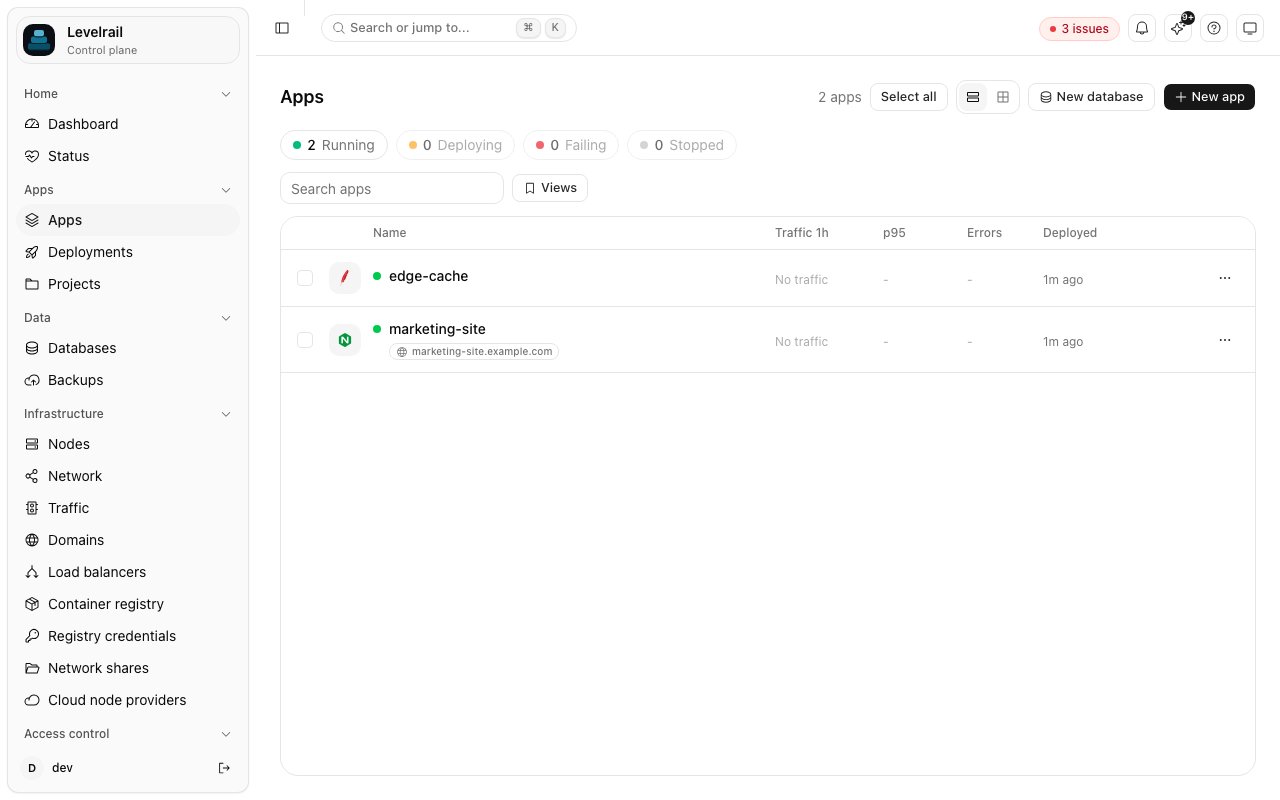 The dashboard list at `/apps` has a status strip (running, deploying, failing, stopped), a search box, environment chips, a tag filter, and a checkbox on every row. The list is virtualized, so hundreds of apps stay responsive.
**Saved views** store the current search, environments and tags under a name. They live in your browser's local storage, not on the server. The control plane has no per-user preference store, so a saved view is yours alone and is not shared.
Over the API:
```bash theme={"dark"}
curl "https://control-plane/api/v1/apps?environment=staging&tag=team:core&q=web&limit=50&offset=0" \
-H "Authorization: Bearer $TOKEN"
curl "https://control-plane/api/v1/apps-summary?environment=production" \
-H "Authorization: Bearer $TOKEN"
```
Apps you are not allowed to read (an IAM Deny on `app:`) are left out of both.
## Bulk actions
Select apps in the list and use the bar that appears at the bottom, or from the CLI:
```bash theme={"dark"}
levelrail-cli apps bulk restart --tag tier:edge --dry-run
levelrail-cli apps bulk add-tag team:core --names web,api --yes
levelrail-cli apps bulk set-environment staging --env development
levelrail-cli apps bulk delete --tag scratch
```
Actions: `redeploy`, `restart`, `stop`, `start`, `add-tag`, `remove-tag`, `set-environment`, `move-to-project`, `delete`.
`POST /api/v1/apps/bulk` takes `action`, one of `names`, `tag` or `environment`, an optional `value`, and `dry_run`. It always answers **207** with one result per app:
| Status | Meaning |
| - | - |
| `ok` | applied |
| `would_apply` | dry run, nothing changed |
| `denied` | your permissions do not allow this action on this app |
| `not_found` | no such app |
| `skipped` | not applicable (for example a redeploy into a protected environment, or a tag cap reached) |
| `error` | the action failed for this app |
Each app is authorized on its own against your abilities and IAM policies, so a denied app never blocks the rest and is never silently dropped. Up to `APP_BULK_CONCURRENCY` (default 4) apps run at once, and a request may name at most `APP_BULK_MAX_APPS` (default 200).
`delete` needs `confirm_names` equal to the exact set of target apps. The dashboard and CLI run a dry run first and fill it from the list you confirmed. Every deleted app gets its own audit log entry. `redeploy` skips apps in protected environments, so approval flows are never bypassed in bulk.
The MCP server exposes `bulk_apps` (mutating) and `bulk_delete_apps` (destructive, gated like other destructive tools).
## Clone an app
```bash theme={"dark"}
levelrail-cli apps clone web web-staging --preview
levelrail-cli apps clone web web-staging --domain-suffix stg --copy-secrets --environment env_abc
```
A clone copies the image, port, command, plain env, secret names, vault references, replicas, strategy, resources, health checks, hooks, egress policy, volume definitions, and project. Here is what it treats differently:
* Domains are never copied as is, because two apps must not answer the same host. By default the clone has none. `--domain-suffix stg` derives `web-stg.example.com` from `web.example.com`.
* Secret values are copied only with `--copy-secrets`, and only if you hold `read:sensitive`. Each value is decrypted and encrypted again under the new app's own key and slot binding.
* Volumes are recreated as new, empty volumes. Copying volume data (`--with-data`) is not supported.
* Scheduled tasks, node placement and deploy history are not copied.
## Promote a release
```bash theme={"dark"}
levelrail-cli apps promote web-staging --to env_prod --preview
levelrail-cli apps promote web-staging --to env_prod --include-env --confirm
```
The preview shows a diff before anything changes: image, replicas, resources, health, and the **names** (never values) of env keys that would be added, removed, or differ. Domains, ports, node placement, volumes and secret values are never touched. Applying sends the source's deployed image reference to the destination and starts a deploy through the normal deploy path. With `--include-env`, env keys the source added or dropped are applied too; keys both apps have keep the destination's own value.
Guardrails:
* Promoting into an environment named `production`, or any protected one, needs `--confirm`. Protected environments also go through deploy approval.
* A source that is unhealthy or whose last deploy failed is refused. `--force` overrides.
* Both apps get an audit log entry.
## Related
Naming rules for the labels bulk actions select on.
Where environments live and how protection works.
This documentation is built and hosted on [Mintlify](https://mintlify.com), a developer documentation platform.
The dashboard list at `/apps` has a status strip (running, deploying, failing, stopped), a search box, environment chips, a tag filter, and a checkbox on every row. The list is virtualized, so hundreds of apps stay responsive.
**Saved views** store the current search, environments and tags under a name. They live in your browser's local storage, not on the server. The control plane has no per-user preference store, so a saved view is yours alone and is not shared.
Over the API:
```bash theme={"dark"}
curl "https://control-plane/api/v1/apps?environment=staging&tag=team:core&q=web&limit=50&offset=0" \
-H "Authorization: Bearer $TOKEN"
curl "https://control-plane/api/v1/apps-summary?environment=production" \
-H "Authorization: Bearer $TOKEN"
```
Apps you are not allowed to read (an IAM Deny on `app:`) are left out of both.
## Bulk actions
Select apps in the list and use the bar that appears at the bottom, or from the CLI:
```bash theme={"dark"}
levelrail-cli apps bulk restart --tag tier:edge --dry-run
levelrail-cli apps bulk add-tag team:core --names web,api --yes
levelrail-cli apps bulk set-environment staging --env development
levelrail-cli apps bulk delete --tag scratch
```
Actions: `redeploy`, `restart`, `stop`, `start`, `add-tag`, `remove-tag`, `set-environment`, `move-to-project`, `delete`.
`POST /api/v1/apps/bulk` takes `action`, one of `names`, `tag` or `environment`, an optional `value`, and `dry_run`. It always answers **207** with one result per app:
| Status | Meaning |
| - | - |
| `ok` | applied |
| `would_apply` | dry run, nothing changed |
| `denied` | your permissions do not allow this action on this app |
| `not_found` | no such app |
| `skipped` | not applicable (for example a redeploy into a protected environment, or a tag cap reached) |
| `error` | the action failed for this app |
Each app is authorized on its own against your abilities and IAM policies, so a denied app never blocks the rest and is never silently dropped. Up to `APP_BULK_CONCURRENCY` (default 4) apps run at once, and a request may name at most `APP_BULK_MAX_APPS` (default 200).
`delete` needs `confirm_names` equal to the exact set of target apps. The dashboard and CLI run a dry run first and fill it from the list you confirmed. Every deleted app gets its own audit log entry. `redeploy` skips apps in protected environments, so approval flows are never bypassed in bulk.
The MCP server exposes `bulk_apps` (mutating) and `bulk_delete_apps` (destructive, gated like other destructive tools).
## Clone an app
```bash theme={"dark"}
levelrail-cli apps clone web web-staging --preview
levelrail-cli apps clone web web-staging --domain-suffix stg --copy-secrets --environment env_abc
```
A clone copies the image, port, command, plain env, secret names, vault references, replicas, strategy, resources, health checks, hooks, egress policy, volume definitions, and project. Here is what it treats differently:
* Domains are never copied as is, because two apps must not answer the same host. By default the clone has none. `--domain-suffix stg` derives `web-stg.example.com` from `web.example.com`.
* Secret values are copied only with `--copy-secrets`, and only if you hold `read:sensitive`. Each value is decrypted and encrypted again under the new app's own key and slot binding.
* Volumes are recreated as new, empty volumes. Copying volume data (`--with-data`) is not supported.
* Scheduled tasks, node placement and deploy history are not copied.
## Promote a release
```bash theme={"dark"}
levelrail-cli apps promote web-staging --to env_prod --preview
levelrail-cli apps promote web-staging --to env_prod --include-env --confirm
```
The preview shows a diff before anything changes: image, replicas, resources, health, and the **names** (never values) of env keys that would be added, removed, or differ. Domains, ports, node placement, volumes and secret values are never touched. Applying sends the source's deployed image reference to the destination and starts a deploy through the normal deploy path. With `--include-env`, env keys the source added or dropped are applied too; keys both apps have keep the destination's own value.
Guardrails:
* Promoting into an environment named `production`, or any protected one, needs `--confirm`. Protected environments also go through deploy approval.
* A source that is unhealthy or whose last deploy failed is refused. `--force` overrides.
* Both apps get an audit log entry.
## Related
Naming rules for the labels bulk actions select on.
Where environments live and how protection works.
This documentation is built and hosted on [Mintlify](https://mintlify.com), a developer documentation platform.